
Data Act: the complete guide to deadlines for (re) negotiating your cloud contracts.
Introduction
The European Data Act regulation is changing the rules of the game for businesses that use cloud services. Gone are the days when you were trapped in a SaaS, IaaS, or PaaS contract with no way out easily. Since the entry into force of this text, customers have regained their freedom of movement and can finally say goodbye to the famous “lock-in” that made changing suppliers so complicated and expensive.
But in concrete terms, what are the deadlines to be respected? When can you cancel? How long should you expect to migrate your data? This article gives you all the keys to understanding and applying the new Data Act rules.
Who is affected by the Data Act?
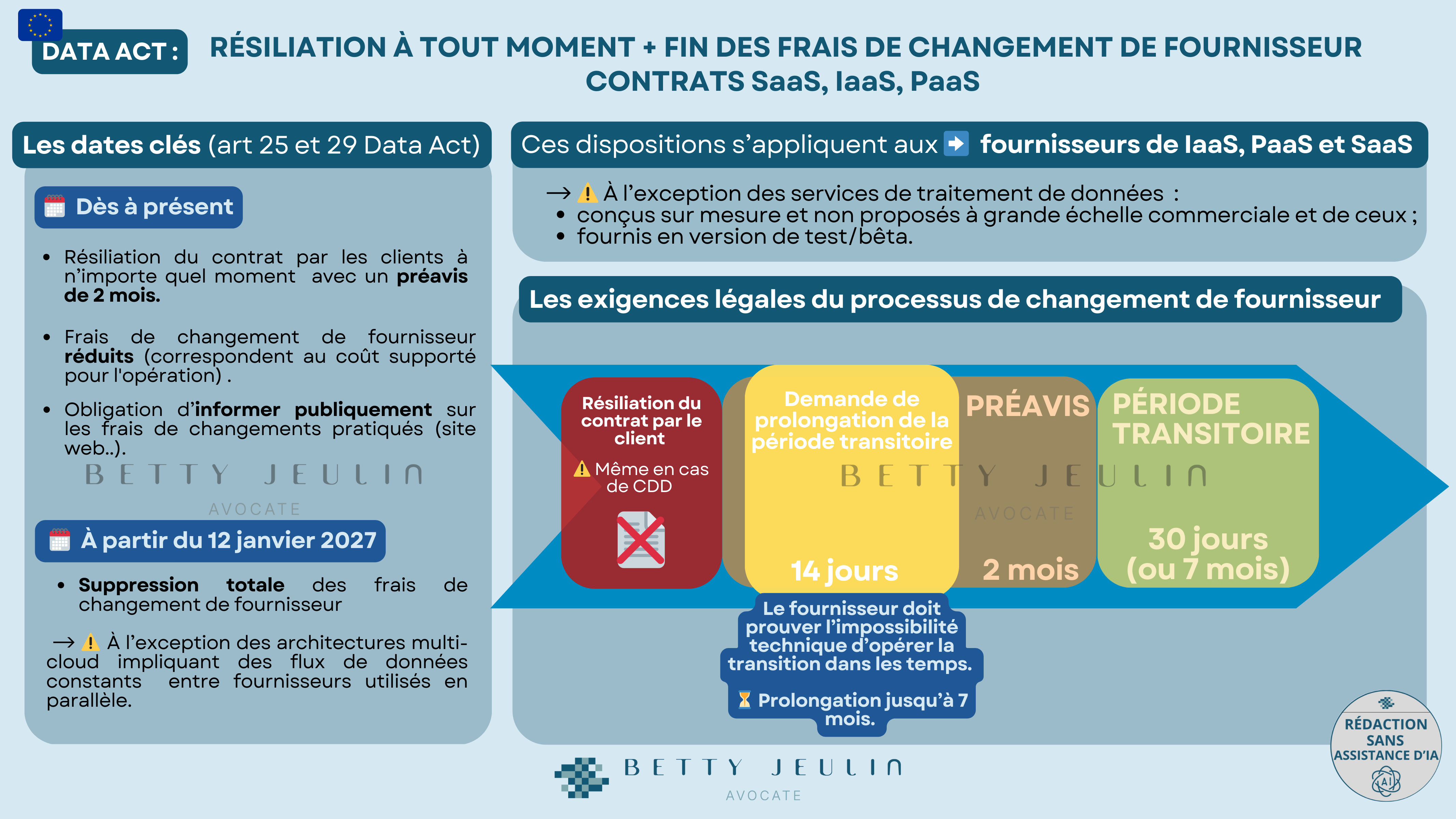
The provisions on termination and change of provider apply to cloud service providers in three main categories:
- SaaS (Software as a Service): applications hosted in the cloud
- IaaS (Infrastructure as a Service): IT infrastructure on demand
- PaaS (Platform as a Service): online development platforms
Exceptions to be aware of
Attention, some services are exempt from these rules. The Data Act does not apply to:
- Custom-designed data processing services not offered on a large commercial scale
- Services provided in test or beta versions
If your supplier offers personalized service only for your business or if you are testing a preliminary version of a product, the classic rules of your contract continue to apply.
The two major revolutions of the Data Act
1. Free cancellation at any time
It's probably the most drastic change. Now you can cancel your cloud contract At any time, even if you signed a fixed-term commitment.
Did you accept a three-year contract to benefit from a preferential rate? It doesn't matter. If after six months you find a better solution elsewhere, you are free to leave. The supplier can no longer hold you back with commitment clauses.
This measure has already been in force since the application of the Data Act.
2. The gradual end of change fees
The other big news is the fees that suppliers used to charge to “make it easier” for you to leave. These costs, which were often prohibitive, were mainly used to discourage you from changing providers.
Until January 12, 2027, suppliers can still charge change fees, but under strict conditions:
- These fees should be Reduced
- They should match strictly at the actual cost of the operation Of migration
- They have to be displayed publicly on the supplier's website
As of January 12, 2027, any change of supplier becomes totally free. Plus one euro to pay to recover your data and migrate to a new provider.
The multi-cloud exception
However, there is one notable exception: multi-cloud architectures.
If you use multiple cloud providers in parallel with constant data flows that flow between them, section 34 of the Data Act allows billing that is limited to actual costs. This exception is justified by the technical complexity of these distributed infrastructures.
The schedule of deadlines to be respected
Now let's get to the heart of the matter: the deadlines you need to incorporate into your contracts and migration processes.
Cancellation notice: 2 months maximum
When you decide to cancel your cloud contract, you should notify your provider with a notice of 2 months maximum.
It is a high limit. Your contract may provide for a shorter period of time (1 month, 15 days...), but in no case can it require more than 2 months of notice. Even if you cancel in the middle of a fixed-term contract.
The standard transition period: 30 days
Once you have notified your departure, the transition period begins. This is the time you have to migrate your data to your new provider.
The standard duration is 30 calendar days. During this month, your former supplier must:
- Maintaining access to your data
- Allow you to export your information
- Facilitating the technical transition
The request for an extension: notification within 14 days
Does your provider think that 30 days is not enough to migrate your data? He can ask for an extension, but he must do it quickly: within 14 working days following your cancellation request.
This notification must be substantiated. The supplier must prove that it is technically impossible for him to make the transition within the standard deadlines and explain why.
The exceptional extension: up to 7 months
If the supplier's arguments are solid and the technical complexity justifies it, the transition period may be extended. up to a maximum of 7 months.
This extension is really exceptional. It generally concerns:
- Migrations of very large volumes of data
- Particularly complex technical architectures
- Critical services requiring a gradual transition
The supplier cannot simply invoke complexity to save time. He must demonstrate the concrete technical impossibility of respecting the initial 30 days.
Practical advice to anticipate your migration
Even if the Data Act greatly facilitates supplier changes, a migration remains a delicate operation that requires preparation. Here are some recommendations:
For cloud services customers
- Audit your current contracts : check that they comply with the Data Act and identify the clauses to be renegotiated
- Document your infrastructure : list precisely the services used, the volumes of data, the technical dependencies
- Plan large : even if the law requires a minimum of 30 days, give yourself more time if your migration is complex
- Test before you switch : take advantage of the transition period to validate that everything works with the new supplier before cutting ties
- Keep evidence : keep all exchanges concerning cancellation and migration (emails, notifications, technical justifications)
For cloud services suppliers
- Adapt your terms and conditions : bring your contracts into compliance with the Data Act without waiting
- Simplify your exit processes : develop effective data export tools
- Train your teams : make sure your sales representatives and support know the new rules
- Communicate clearly : display the required information prominently on your site
- Anticipate requests : prepare sample answers for termination and migration questions
Need help bringing your cloud contracts into compliance with the Data Act? The firm assists you in auditing and renegotiating your agreements with your cloud service providers. Contact us to discuss it.