
Renaud Dekode Interview: Generative AI and Legal Framework
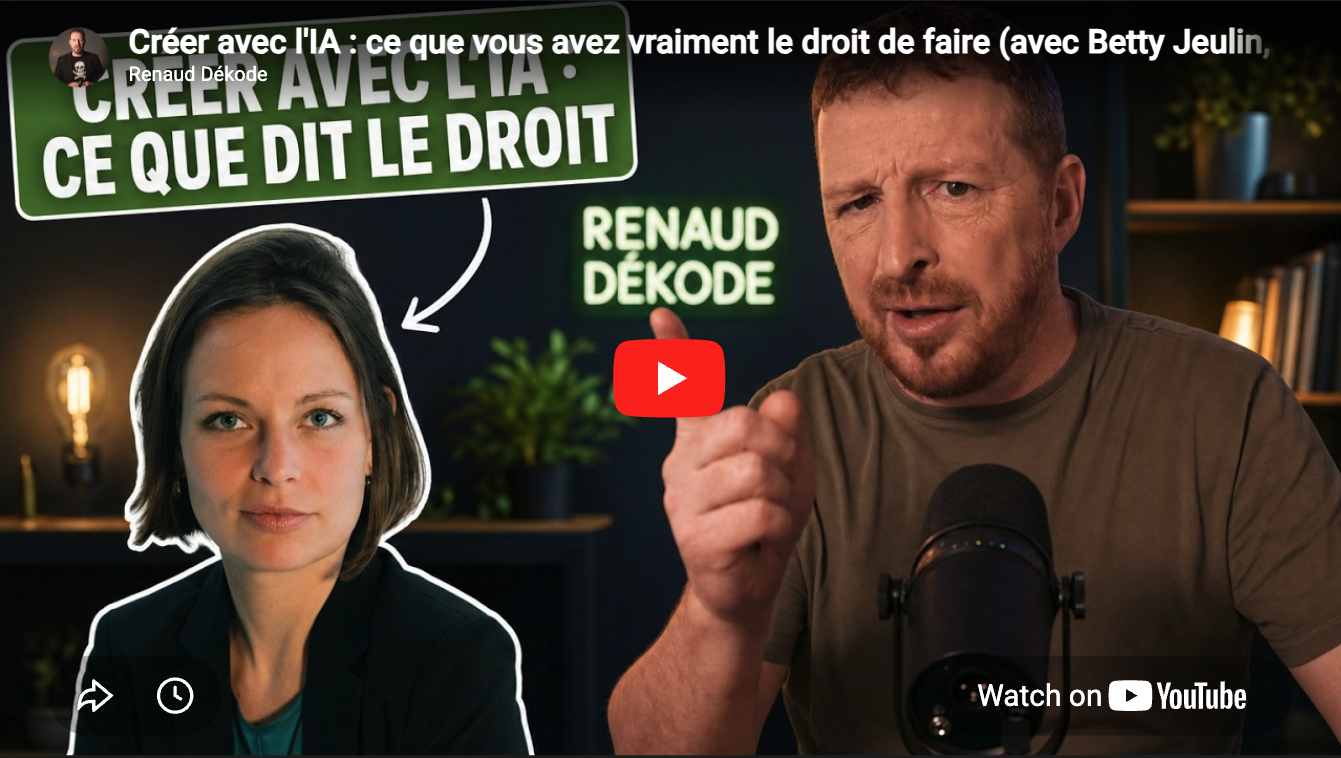
AI and Law: A Look Back at My Discussion with Renaud Dékode
Betty Jeulin had the pleasure of being a guest of Renaud Dékode for a discussion dedicated to the legal challenges of generative AI for creators, freelancers, agencies, and businesses.
Topics Covered
The interview was designed to answer the practical questions that users of tools like ChatGPT, Midjourney, ElevenLabs, Suno, HeyGen, or Sora encounter daily. We specifically addressed:
- the question of copyright as applied to AI-generated content, and identifying the author among the user, the tool publisher, and the model itself;
- the legal conditions for training models on protected content;
- transparency obligations regarding the use of AI in content creation;
- what the AI Act concretely changes for creators, platforms, and businesses, along with its implementation timeline;
- voice cloning and deepfakes, the line between legitimate use and infringement of personal rights;
- AI avatars in training and e-learning, and the contractual precautions to consider;
- AI-generated music, its monetization on YouTube, and the associated legal risks;
- the pitfalls of AI tool Terms of Use, particularly regarding rights transfers, content reuse, and confidentiality;
- the clauses to include in client contracts when delivering partially AI-generated content.
Betty Jeulin also took a broader perspective on two fundamental questions: can copyright still hold up against the instant generation of content, and how are French and European judges beginning to position themselves on the first AI-related disputes?